
An Innovative Approach to Building Long-Lasting Structures: Pretensioned Prestressed Concrete in Construction
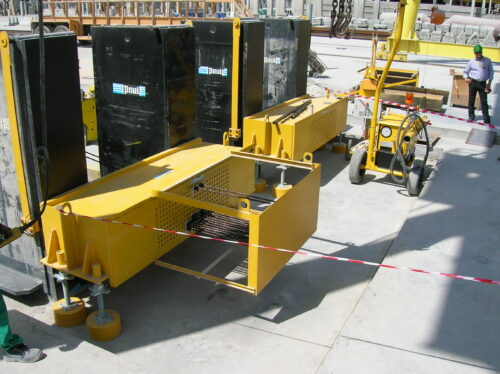 Pretensioned prestressed concrete (PPC) has become a benchmark for quality in today’s construction industry, where material efficiency and reliability determine the success of any project. Technology keeps moving forward, offering solutions that significantly outperform traditional methods in terms of strength and economic value. Pretensioned prestressed concrete enables the construction of architecturally complex buildings with lower material consumption while ensuring exceptional operational safety.
Mechanics of Strength: How the Stressing Technology Works
The method is based on compensating for concrete’s primary weakness – its low tensile strength. The technological process creates an artificial compressive stress inside the element before it is installed.
The production cycle looks as follows:
- Pre-tensioning. Reinforcement (wire or steel strands) is placed in the mould and tensioned using specialized equipment – mechanical jacks or an electro-thermal method.
- Concreting. Concrete mix is poured over the prepared reinforcement that is held under very high stress.
- Force transfer. After the concrete reaches the required strength, the reinforcement is released. As it tries to return to its original length, it compresses the surrounding concrete.
That is how pretensioned prestressed concrete is produced – an element with a unique internal structure. The resulting product actively resists external loads, preventing the cracking and deflection typical of conventional reinforced concrete. For reliable implementation of this process, it is critical to use high-quality hydraulic power packs, jacks, and anchorage grips that ensure accurate stressing force.
Areas of Application: From Commercial to Industrial
The versatility of the material opens wide horizons for designers and architects. Thanks to the ability to span large distances without intermediate supports, the technology is in demand across many sectors:
- Residential complexes: flexible apartment layouts due to the absence of load-bearing walls within the perimeter.
- Shopping and office centers: spacious halls and atriums requiring a minimum number of columns.
- Industrial facilities and warehouses: workshops with high floor loads and wide spans for equipment operation.
- Seismic regions: increased resistance of structures to dynamic loads.
By adopting pretensioned prestressed concrete, developers can bring bold architectural concepts to life, varying the building outline and interior space without being constrained by the limitations of older technologies.
Economic Value and Technical Advantages
The popularity of the technology is driven not only by strength characteristics, but also by hard numbers. Using prestressed structures can make an investment project more profitable – revenue from sales can increase by 35% compared to traditional methods.
Key efficiency factors:
- Reduced material intensity. Reinforcing steel consumption can be reduced by up to 50%, and the total volume of concrete is decreased, lowering the building’s weight by about 40%. This, in turn, reduces foundation costs.
- Durability. Resistance to cracking is 2-3 times higher, minimizing future repair and maintenance costs.
- Speed and logistics. Lower product weight simplifies transportation and installation, accelerating project delivery.
Proper use of this method can reduce the overall material intensity of construction by up to 27%, which is a strong argument amid steadily rising prices for building materials.
A Reliable Partner for Your Production
To implement pretensioned prestressed concrete and reach a new level of profitability, you need dependable equipment. The Finnish company TDM Engineering Oy offers end-to-end solutions for organizing precast concrete production – from extruders and saws to high-precision stressing systems.
We supply time-proven hydraulic power packs, jacks, and anchorage grips from Paul Maschinenfabrik, and we provide professional engineering support. Contact us to get an engineer’s consultation and equip your plant with advanced technologies that will become the foundation of your market leadership.
Expert Blitz: 6 Key Facts About the Technology (Q&A)
- What is the main principle of the technology?
The essence lies in creating artificial compressive stress inside the concrete at the production stage. Because concrete resists tension poorly, pre-tensioned reinforcement compresses the material after the mix hardens, compensating for future tensile loads.
2. How much does material intensity decrease?
Using pretensioned prestressed concrete can reduce reinforcing steel consumption by up to 50% and lower the total building weight by about 40%, significantly reducing the load on the foundation.
3. What is the economic benefit for a developer?
Projects that use this technology often show higher profitability. According to the stated figures, profit from such projects can increase by 35% compared to traditional construction methods.
4. How does the technology affect durability?
Products have higher stiffness and crack resistance – 2-3 times higher than conventional reinforced concrete – which reduces the risk of deflection.
5. What stressing methods exist?
Depending on plant equipment, three methods are used: mechanical (hydraulic jacks), electro-thermal (electric heating), or a combined electro-thermo-mechanical method.
6. Where can such structures be used?
The technology is universal and is used in residential construction, office centers, warehouses and industrial buildings, and it is especially effective in regions with high seismic activity.