
Prestressed and post-tensioned concrete technology: a modern solution for cost-effective production
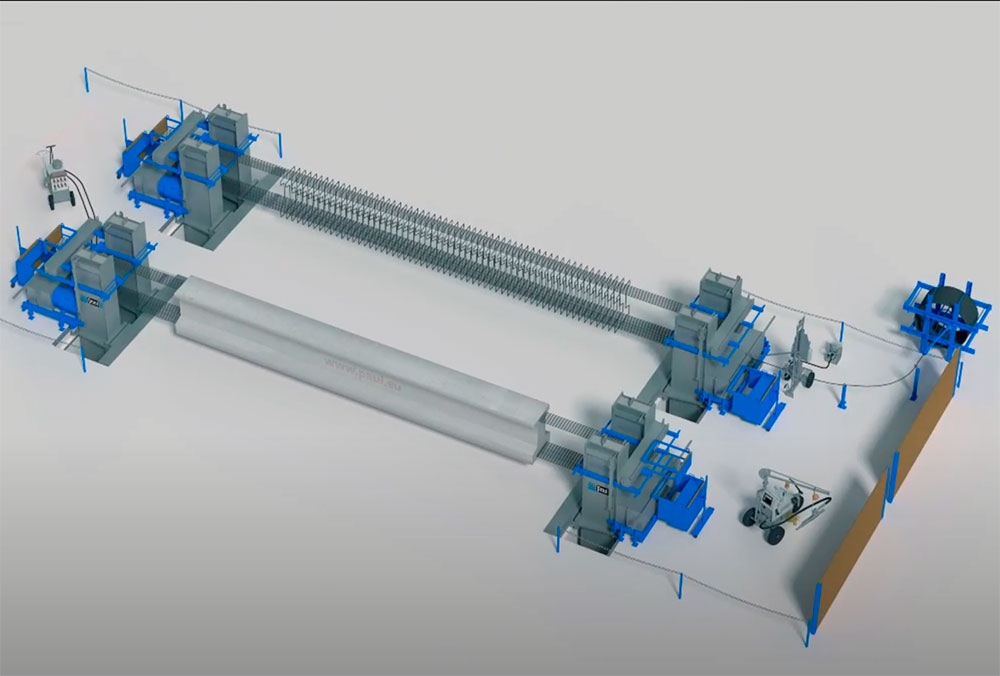 Modern production places increasingly stringent demands on the strength, durability, and cost-effectiveness of reinforced concrete structures. In these conditions, prestressed and post-tensioned concrete technology becomes a key tool for optimizing projects and reducing material and maintenance costs. This technology is widely used in advanced precast concrete plants and allows the production of products with high load-bearing capacity and smaller dimensions.
How prestressed and post-tensioned concrete technology works
Prestressed reinforced concrete is reinforced concrete in which the reinforcement strands are tensioned in advance, creating internal compressive stresses in the structure. This compensates for the tensile forces that arise during operation. If the tension is created before the concrete hardens, it is called pre-tensioning technology. If the forces are transferred to the concrete after it has hardened through an anchor system, it is called post-tensioned concrete.
Both technologies achieve the effect of internal compression, which significantly increases the strength characteristics of reinforced concrete products and reduces the risk of cracking. From a production process perspective, pre-tensioning is more commonly used in linear molding stands, while post-tensioning is used in monolithic construction projects and complex architectural forms.
Real-world application of the technology in production
In practice, prestressed and post-tensioned concrete technology is widely used in the production of hollow core slabs, beams, girders, and other load-bearing elements. In factories where the pre-tensioning method is used, metal cables are secured in anchor blocks and tensioned with jacks before concreting. After gaining strength, the concrete retains the tension, ensuring high load-bearing capacity with minimal weight.
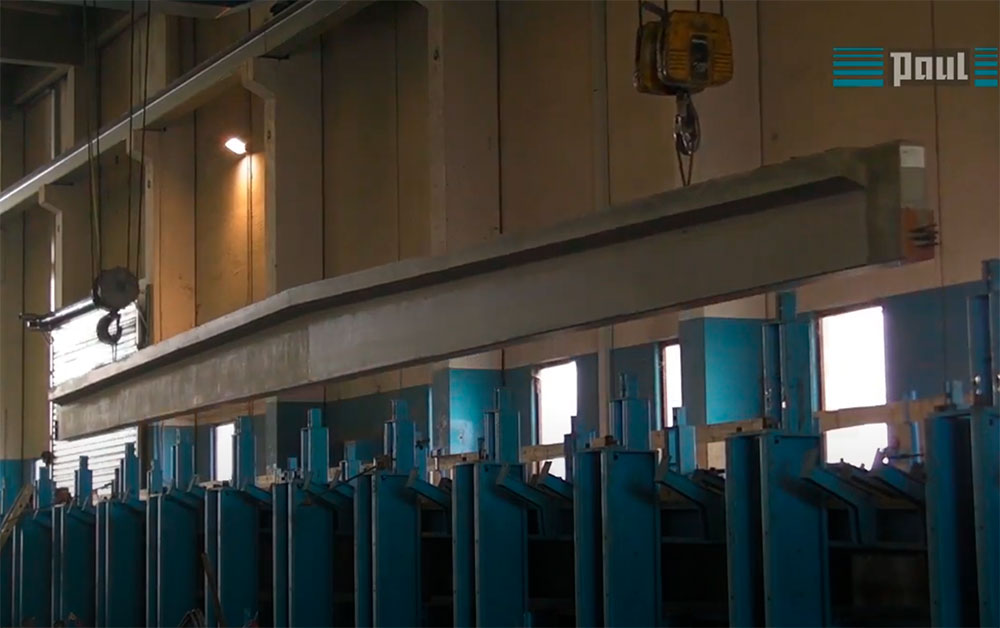
In the case of post-tensioned concrete, the cables are laid in sleeves inside the product and tensioned after it has hardened. This is especially important in the case of non-standard projects or when installing structures on a construction site.
Advantages and benefits of implementing the technology
The main advantage of prestressed and post-tensioned concrete technology is the ability to reduce the consumption of reinforcement and concrete without compromising the strength of the product. Internal compression allows cracking to be completely eliminated or minimized, even under significant operational loads. In addition, the products are lighter in weight, which simplifies transportation and installation.
Other benefits include increased spans without additional support, reduced manufacturing time, increased geometric accuracy, and operational reliability. All these factors make the technology particularly relevant for industrial, commercial, and infrastructure projects.
A ready-made solution from TDM specialists
If you are looking for a way to improve the quality and profitability of reinforced concrete production, prestressed and post-tensioned concrete technology is a proven solution. TDM offers comprehensive support for the implementation of this technology: from the design of molds and tensioning systems to the supply of equipment and technical support.
Contact us to get a ready-made solution tailored to your tasks and production capacities.