
Revolution in Concrete Forming: How to Reduce Costs and Increase Dimensional Accuracy — High‑Performance Magnetic Formwork Systems for Precast Concrete
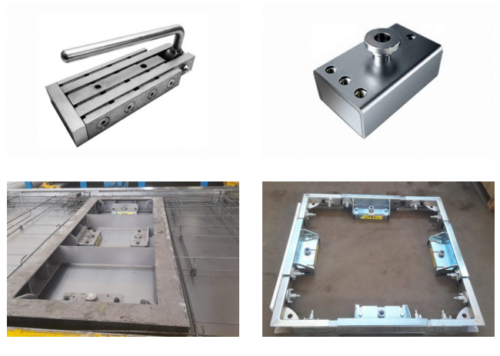
The modern precast concrete industry demands not only high production speed but also impeccable dimensional precision of finished elements. Traditional methods of fixing formwork side rails using welding or bolted joints are now obsolete—they damage expensive casting beds and consume valuable production time. An efficient solution to this challenge lies in high‑performance magnetic formwork systems for precast concrete, which allow operators to instantly and securely fix side rails and embedded parts. This technology, implemented by TDM Extruder, fundamentally transforms production workflows across plants of any size.
Technological Core of the System: Neodymium Encapsulated in Steel
The essence of the innovation is the use of powerful neodymium‑based magnets enclosed in a robust steel housing. This is not just a magnet but a sophisticated engineered module commonly referred to as a magnetic box. Its working principle is both simple and brilliant: the operator places the module at the required position on the steel casting table and activates the magnetic field by pressing a button or lever. At that moment, the magnetic formwork units generate a clamping force strong enough to withstand tons of concrete during vibration compaction, preventing any displacement.
To release the formwork, a special lifting tool is used to disengage the magnet. Importantly, when the magnet is deactivated, it produces no magnetic attraction, ensuring easy repositioning and full safety for operators. The steel housing protects the internal components from concrete contamination, guaranteeing long service life even under harsh factory conditions.
From Hollow‑Core Slabs to Architectural Elements
The application range of this tooling extends far beyond standard products. TDM Engineering Oy technology offers maximum flexibility. High‑performance magnetic formwork systems are ideal for the production of hollow‑core slabs, wall panels, stair flights, and ventilation blocks. With the use of various adapters, magnetic boxes can be connected to virtually any type of side form—plywood, steel, or timber.
This magnetic system is especially valuable when product dimensions must be changed frequently. Previously, reconfiguring the line could take hours of welding work, whereas now, repositioning side rails for a new product size takes only minutes. This allows factories to respond rapidly to custom orders without additional investment in extra tooling.
Economic Efficiency and Asset Protection
The primary argument in favor of magnetic fixation is cost efficiency. First, welding on the casting bed is completely eliminated. This means the table surface remains perfectly smooth, free of weld beads or pitting—directly improving the finish of the concrete product. This also eliminates regular expenses for grinding and table refurbishment.
Second, magnetic formwork systems ensure mathematical dimensional accuracy. The rigid fixation prevents concrete bulging, reducing rejection rates and minimizing concrete waste. Another significant advantage is universality: a single set of magnets can be used for years across dozens of product types.
Time to Modernize Production
Continuing to rely on outdated fixing methods results in direct financial loss. Switching to modern fixation systems from TDM Extruder is an investment in speed, quality, and long‑term preservation of your equipment. You gain a technology that pays for itself through reduced labor hours and extended lifespan of casting beds.
Contact TDM Extruder specialists today to select the optimal magnetic tooling configuration for your plant and elevate your production to a new level of efficiency.
Expert Quick Guide: Answers to Key Questions About the Technology
1. What is the main economic benefit of magnetic formwork? Eliminating welding and bolted connections. This extends the service life of casting beds by 2–3 times and reduces reconfiguration time by up to 70%.
2. What is the lifespan of magnetic boxes? With proper maintenance (cleaning from concrete, lubrication), the equipment lasts more than 10 years. Neodymium retains its magnetic properties for decades.
3. Can one system be used for different products? Yes. Magnetic modules are universal. With adapters, they attach to any type of side form (wood, steel, plywood) and are suitable for slabs, piles, columns, and ventilation blocks.
4. Can magnets damage the surface of the casting bed? No. Fixation occurs solely by magnetic force. No mechanical impact, drilling, or welding is required—the table surface remains perfectly smooth.
5. Is the technology difficult to implement on an existing plant? No. The system is compatible with all steel casting beds. Staff training requires minimal time because the operation is intuitive.
6. How reliable is the fixation under heavy vibration? Completely reliable. The pull‑off force of a single magnetic box reaches several tons (depending on model), guaranteeing stability even under intense vibration compaction.