
Where to Invest in a Precast Concrete Slab Production Line: Technologies and Equipment from Market Leaders
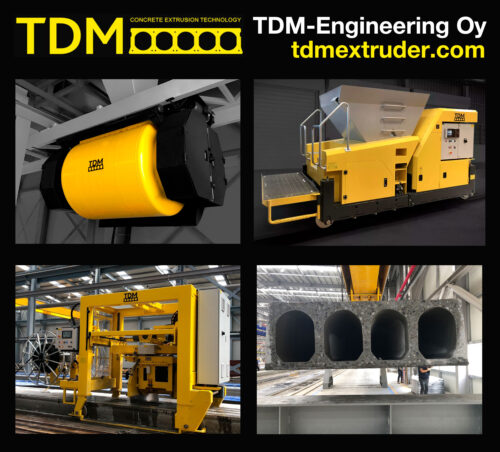
Modern civil and industrial construction demands maximum execution speed while maintaining uncompromising structural quality. Traditional forming methods for precast concrete elements are gradually being replaced by high-tech solutions. Production optimization begins with selecting the right equipment that reduces manufacturing costs and expands product range.
If you are planning to scale your business or modernize your plant, investing in a precast concrete slab production line based on Finnish TDM Engineering technology and PAUL equipment will become the foundation of your competitive advantage.
The Principle of Slipforming Technology
At the core of modern slab production lies the method of continuous slipforming on long casting beds. Instead of using hundreds of heavy steel molds, the concrete mix is fed into a specialized forming machine — an extruder. The machine moves along steel casting beds, leaving behind a continuous strip of compacted concrete with precisely defined geometry.
Reinforcement is introduced through prestressing of steel strands or wires. Precision at this stage is critical: PAUL prestressing equipment ensures uniform and controlled tensioning, eliminating sagging and guaranteeing the correct structural camber of each slab.
After the concrete reaches the required strength, the continuous strip is cut with diamond saws into products of the specified length. This allows slab production in 100 mm increments — a level of flexibility that is practically unattainable in carousel or stationary mold production systems.
Applications in Civil and Industrial Construction
Flexible equipment configuration allows manufacturers to meet the demands of diverse construction projects. These lines produce not only standard hollow core slabs, but also solid slabs, piles, lintels, and T-beams.
In practice, this means a plant can quickly switch from producing standard residential slabs to manufacturing long-span elements (up to 18–20 meters) for shopping centers, warehouse facilities, or logistics hubs.
High load-bearing capacity, achieved through precise prestressing of reinforcement, enables application in seismic regions and in projects requiring increased floor load performance. Investing in a high-end precast concrete slab production line opens access to government tenders and large-scale commercial contracts.
Key Advantages of Integrating PAUL Systems
Integration of PAUL prestressing systems into the TDM Engineering technological chain provides manufacturers with significant advantages:
- Maximum tensioning accuracy – PAUL hydraulic jacks and power units allow force control with kilogram-level precision, ensuring consistent mechanical performance across the entire production batch.
- Reduced steel consumption – Efficient use of prestressing technology reduces steel usage by 5–15% while maintaining calculated structural loads.
- Durability and reliability – German-engineered PAUL components ensure minimal downtime and extended service intervals, even under three-shift operation.
- Personnel safety – Automated gripping and anchoring systems minimize operational risks during high-tension prestressing processes.
- Economic efficiency – Fast return on investment through automation and the possibility to configure the production line according to specific plant requirements.
Comprehensive Solutions for Your Plant
Selecting production capacity is an investment in the future of your enterprise. TDM Engineering Oy offers not just individual machines, but fully synchronized technological processes. We integrate leading global solutions, including PAUL prestressing systems and high-performance S and N series extruders, into your production structure.
If your goal is leadership in the construction materials market, now is the right time to invest in a precast concrete slab production line that ensures stable profitability and a strong brand reputation.
We provide full engineering support, commissioning, and personnel training. Contact our specialists to receive a detailed technical and economic feasibility assessment for your project.
Frequently Asked Questions about Precast Concrete Equipment
What is the production capacity of one casting line?
Average output ranges from 500 to 1,200 linear meters per day, depending on the number of casting beds and extruder speed.
Can different types of products be manufactured on one line?
Yes. Rapid changeover of forming tools allows switching from hollow core slabs to piles, beams, or road slabs within a single working day.
What concrete grade is required for slipforming?
Low-slump, high-strength concrete (C30/37 to C60/75) with a low water-cement ratio is used to ensure immediate shape stability of the concrete strip.
What facility size is required?
A standard casting bed length is 100–150 meters. The recommended minimum workshop span width for 4–5 casting beds is 18–24 meters.
What is the advantage of PAUL equipment compared to alternatives?
PAUL gripping collets and hydraulic systems are globally recognized for reliability, providing up to 2,000 tensioning cycles without replacement of consumable elements — critical for continuous production.