
Investing in Efficiency: A Modern Approach to Hollow-Core Precast Concrete Production
 The construction industry operates under strict time constraints, and the success of any precast concrete plant depends directly on the speed and quality of its output. In a highly competitive environment, those who adopt advanced technologies gain a decisive advantage. Reliable hollow-core slab production equipment forms the foundation of a profitable prestressed concrete operation. Modernizing the production line not only reduces manufacturing costs but also ensures precise product geometry — a critical requ…
Technological Superiority of Long-Line Extrusion
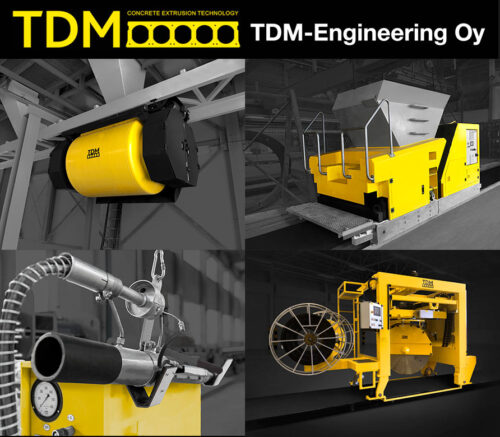
At the heart of this technology is the extrusion method on long prestressing beds. The central component of the production line is the extruder (such as the TDM S, N, or L series), which travels along rails over a heated steel casting bed. The machine processes a low water-cement ratio concrete mix, feeding it through augers into a forming chamber.
The process consists of the following stages:
- Preparing the casting bed and tensioning prestressing wires or strands
- Passing of the extruder, which compacts the concrete under high pressure while forming hollow cores and slab edges
- Thermal curing to develop structural strength
- Cutting the continuous concrete ribbon into slabs of the required length
It is this specialized hollow‑core production equipment that achieves the high concrete density unattainable with cassette or traditional formwork methods.
Universal Solutions for Any Production Scale
Hollow-core slabs manufactured via extrusion are widely used across many sectors. Thanks to the capability to produce elements from 120 to 500 mm in height (depending on the extruder series — S, N, or L), these products are in demand for:
- Residential construction — from private houses to high‑rise residential complexes
- Commercial buildings — shopping malls, office facilities, parking structures
- Industrial applications — warehouses and logistics hubs requiring high load-bearing capacity and long spans
Flexible configuration allows manufacturers to quickly adjust hollow‑core slab equipment to current market needs, producing both standard 1200 mm slabs and narrower elements.
Economic Benefits and Key Arguments
Selecting an extrusion-based slip‑form production line is supported by clear economic indicators. First, cement consumption can be reduced by 30–50% compared with traditional methods, owing to high compaction efficiency and the presence of hollow cores. Second, there is no need to invest in costly metal molds — extrusion takes place on a single smooth casting bed.
Advantages of TDM Engineering Technologies:
- Speed: Up to 2–3 meters of slab produced per minute
- Automation: Minimal human-factor influence
- Durability: Augers and forming components made from wear‑resistant alloys
- Quality: A perfectly smooth top surface requiring no additional screeding or leveling
Properly selected hollow‑core precast equipment achieves payback significantly faster than outdated vibrating table systems.
A Reliable Partnership for Sustainable Growth
TDM Engineering offers not just machinery, but comprehensive solutions for your production facility. Finnish engineering expertise, adapted to modern industrial requirements, ensures reliable, continuous operation of your production line for many years. We provide full lifecycle support — from installation supervision and staff training to spare parts supply and technical service.
By choosing TDM Engineering, you obtain state‑of‑the‑art hollow‑core extruders, universal concrete cutting saws, and long-term operational confidence. Contact us to receive a tailored commercial proposal and elevate your production to the next level.